

GitHub today made a bevy of updates that collectively promise to make it simpler for DevOps teams to build and maintain workflows using artificial intelligence (AI) agents.
Announced at the GitHub Universe conference, Jay Parikh, executive vice president for CoreAI at Microsoft, also provided additional insights into the investments that Microsoft is making to ensure the GitHub platform is able to handle the strain millions of AI agents will place on its infrastructure.
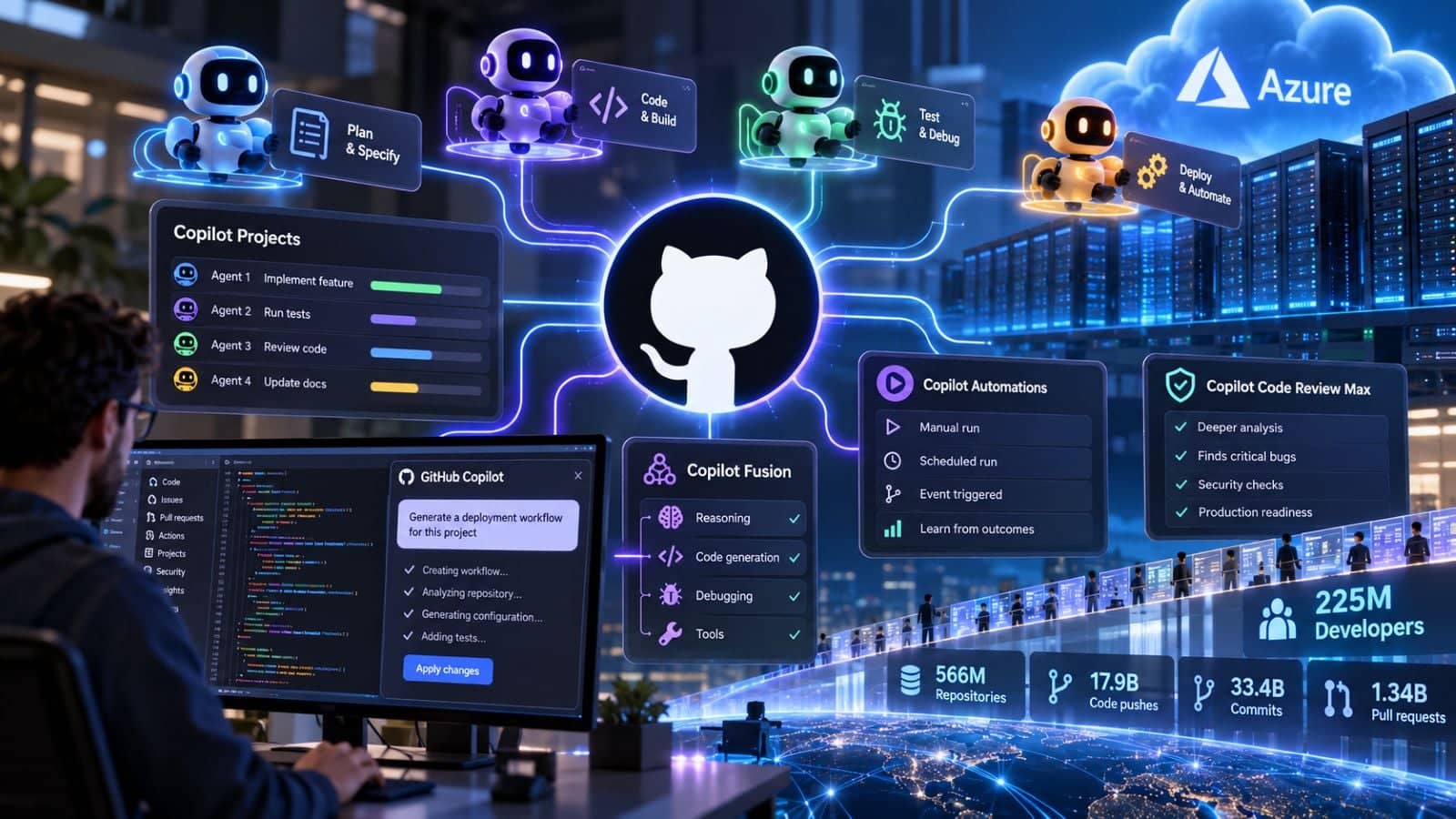
At the core of the GitHub approach to agentic AI engineering is a GitHub Copilot application that DevOps teams can use to connect AI agents and tools across multiple projects in a way that makes it easier to create specifications and analyze telemetry data. GitHub is also now making generally available a Copilot projects tool within the GitHub Copilot application to track the progress multiple AI agents are making across sessions running in parallel.
There is also Copilot Fusion, an orchestration framework that now evaluates what a task needs across reasoning, code generation, debugging, and tools before determining how best to execute a task spanning one or more AI models. GitHub is also extending Copilot automations, a cloud-based service that DevOps teams can either manually invoke, schedule to automatically run at specific times of day or kick off in response to specific events. Those automations can now also learn from outcomes to propose improvements to those workflows.
GitHub is also adding an additional tier for reviewing code: a Copilot code review Max option that analyzes code more deeply to surface bugs that should be remediated before code is promoted into a production environment.
Finally, GitHub also announced that enterprise customers will no longer have to incur a separate licensing fee for using its agentic AI tools beyond the cost of invoking underlying AI models. GitHub Enterprise customers can use all Copilot features without a separate subscription.
Parikh told conference attendees that the SDLC is no longer linear as workflows continue to collapse in the agentic AI era. Instead, developers are using AI agents to execute tasks in parallel, which in turn means every element of the GitHub stack needs to evolve, he added.
Developers, in the meantime, are more important than ever as the rate at which applications are being developed continues to exponentially increase, said Parikh. In fact, all the software written to date will amount to less than 1% of the software that will be written in the next five years, he predicted.
Microsoft, as part of its committment to revamping GitHub infrastructure for the agentic AI era of application development, has added four million CPU cores, 160 PB of high-speed storage and 50 Tb/s network capacity in the last year. Microsoft by the beginning of 2027 also expects to complete a GitHub migration to a multi-region environment on Azure to ensure capacity is able to scale out as needed.
That effort follows a series of outages in the past year that, in part, is attributable to the increased demand for capacity that is being driven by AI agents that have been added to the software development lifecycle (SDLC), said Parikh. There are now 225 million developers on the GitHub platform, resulting in 17.9 billion code pushes, 33.4 billion commits and 1.34 billion pull requests. There are now also 566 million open source projects and repositories on the platform. “We will and must do better,” said Parikh.
The issue, of course, is that as millions of AI agents invoke all the infrastructure available to build, test and deploy applications, it may still not be enough to support an ecosystem that, for the second year in a row, has added every second a new developer to the GitHub platform.


Mike Vizard is a veteran IT journalist with more than 25 years of experience covering the technology industry, having previously served as Editor-in-Chief of both CRN and InfoWorld and as editorial director for Ziff-Davis Enterprise, where he oversaw titles including eWEEK, CIO Insight and Baseline. Over his career he has also edited or contributed to a wide range of enterprise technology publications, including IT Business Edge, Channel Insider, ComputerWorld, TMCNet and Digital Review, and he later led editorial for CTOEdge.com. His reporting and analysis span software development, cloud computing, cybersecurity, IT channel strategy and, more recently, artificial intelligence and DevOps practices. A recognized voice in enterprise IT journalism, Vizard is known for tracking emerging technology trends as they move from early adoption into mainstream enterprise use. He now serves as Chief Content Officer for Techstrong Group, where he oversees editorial strategy across the full network — DevOps.com, Security Boulevard, Cloud Native Now, Digital CxO, Techstrong.ai, TechStrong.IT, Techstrong Semi and PlatformEngineering.com — in addition to writing and hosting content for Techstrong TV and the Techstrong Gang podcast.