

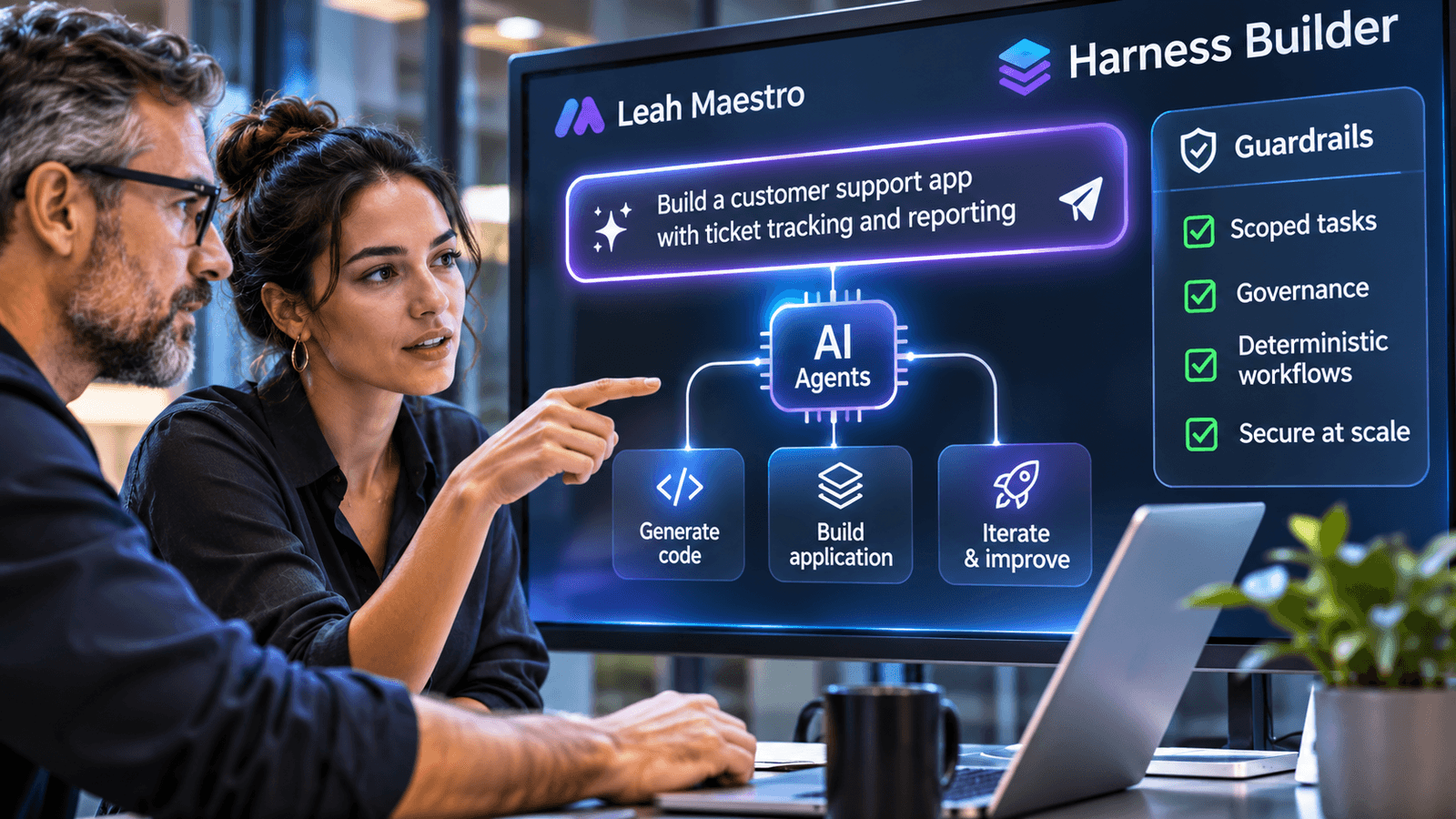
Leah this week added a natural language harness to a Maestro platform it developed to leverage artificial intelligence (AI) models and agents to build applications.
Anurag Malik, president and CTO of Leah, said Harness Builder makes it possible for both citizen and professional developers to iteratively create applications by expressing an intent that an AI agent then uses to generate code.
That capability promises to make it simpler for subject matter experts within an organization to either independently build applications or collaboratively work with professional developers.
Leah originally developed a platform for managing contracts, but is now extending its reach into application development, said Malik. The goal is to make it possible for organizations to build applications using a Maestro software factory that provides access to AI agents that have been trained by Leah.
Additionally, Leah has developed a set of guardrails that ensure the scope of the tasks being performed by any given AI agent are limited, noted Malik. That governance capability also plays a significant role in making it possible to inject a probabilistic AI agent into a deterministic workflow that needs to be completed the same way every time, he added.
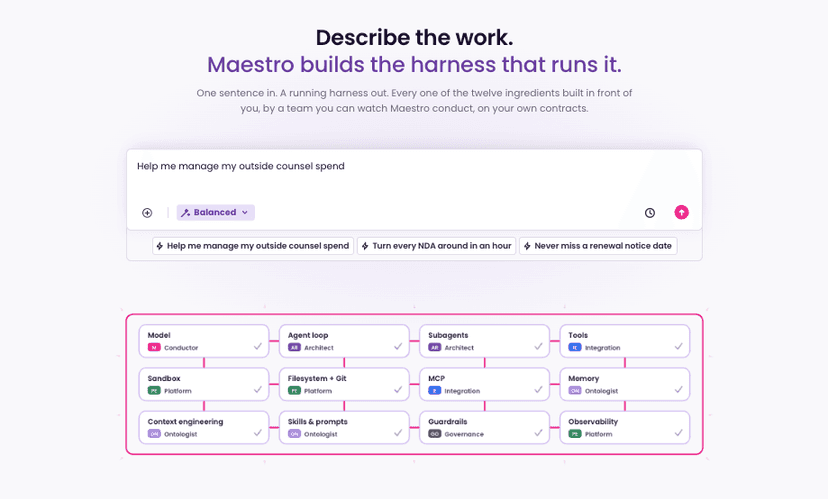
It’s still early days so far as usage of AI agents to build and deploy applications is concerned, but more DevOps teams are starting to construct software factories made up of AI agents to build and continuously update an application. Rather than building a single factory to build every application, a factory that a human software engineer typically oversees is instead created for each application.
That software factory is usually based on a hierarchy of AI agents, with senior-level agents that engage with humans issuing instructions to a large number of sub-agents that either manage or execute a task. The challenge, of course, is that AI agents require a significant amount of ongoing guidance from a software engineer to remain focused on the mission. In general, the more explicit the instructions to AI agents are, the better the output generated will become, said Malik.
It’s not clear to what degree AI software factories will accelerate the overall pace of application development. In many cases, DevOps teams are already leveraging AI to both develop new applications and update existing ones faster than organizations can, from a change management perspective, absorb. Builders of those applications, however, will argue that the pace at which software is deployed and updated directly impacts the ability of any organization to compete.
Regardless of where any organization falls on that spectrum, DevOps teams should expect to be working more closely with subject matter experts to iteratively build applications. In fact, the line between end users and application developers is going to become indistinguishable soon as more end users invoke AI agents to build software. The challenge then becomes how to apply all the rigor needed to ensure that all the applications being generated by an AI software factory are secure enough to be deployed at scale.

Frequently Asked Questions
1. What is Leah's Harness Builder?
2. How does Leah keep AI-generated applications under control?
3. What does AI-driven application development mean for DevOps teams?

Mike Vizard is a veteran IT journalist with more than 25 years of experience covering the technology industry, having previously served as Editor-in-Chief of both CRN and InfoWorld and as editorial director for Ziff-Davis Enterprise, where he oversaw titles including eWEEK, CIO Insight and Baseline. Over his career he has also edited or contributed to a wide range of enterprise technology publications, including IT Business Edge, Channel Insider, ComputerWorld, TMCNet and Digital Review, and he later led editorial for CTOEdge.com. His reporting and analysis span software development, cloud computing, cybersecurity, IT channel strategy and, more recently, artificial intelligence and DevOps practices. A recognized voice in enterprise IT journalism, Vizard is known for tracking emerging technology trends as they move from early adoption into mainstream enterprise use. He now serves as Chief Content Officer for Techstrong Group, where he oversees editorial strategy across the full network — DevOps.com, Security Boulevard, Cloud Native Now, Digital CxO, Techstrong.ai, TechStrong.IT, Techstrong Semi and PlatformEngineering.com — in addition to writing and hosting content for Techstrong TV and the Techstrong Gang podcast.