

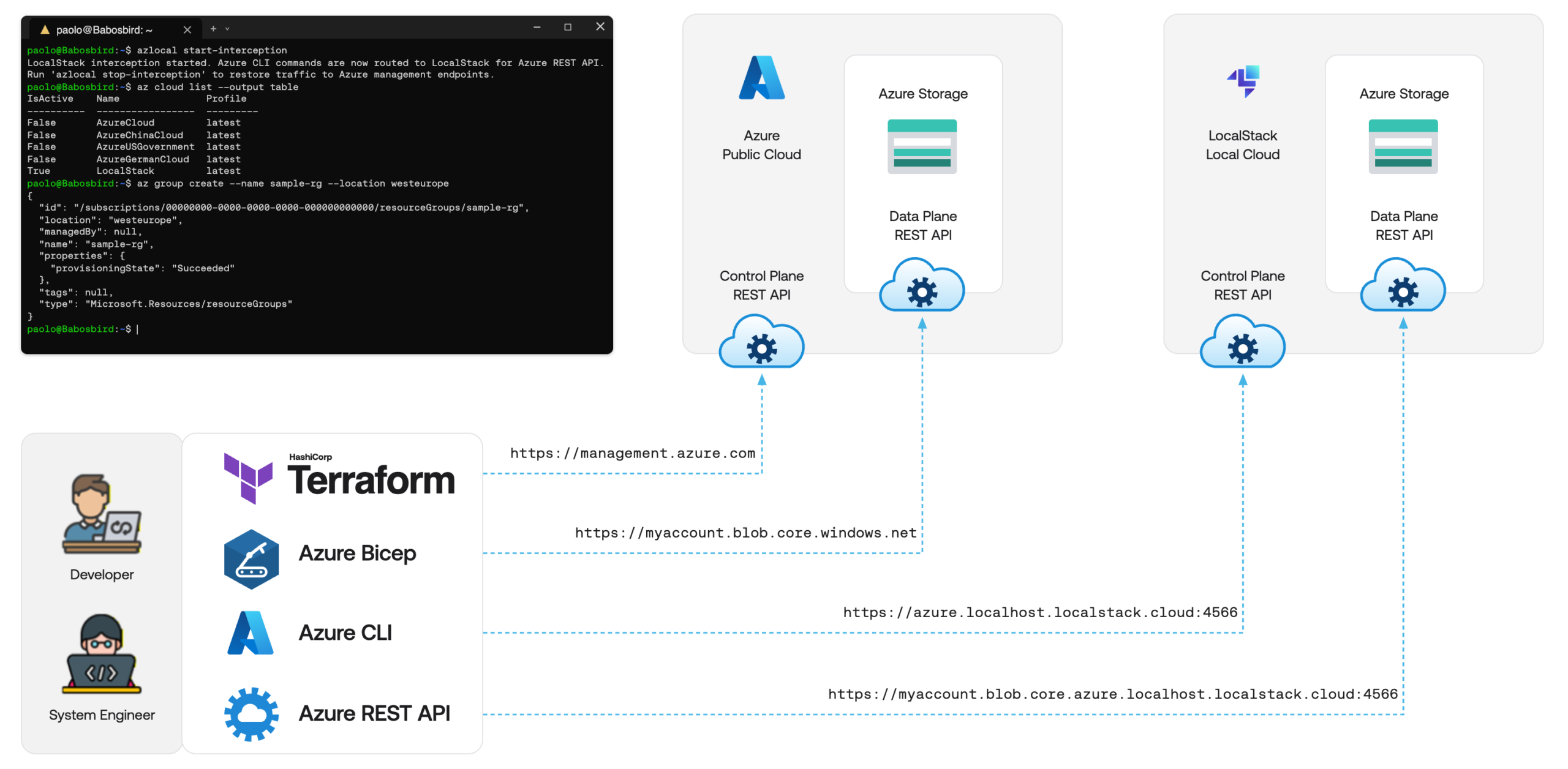
LocalStack has made available a public beta of its platform that enables application developers to emulate Microsoft Azure cloud services on their local machines.
Colin Neagle, head of marketing for LocalStack, said LocalStack now enables application developers to build software locally that can run across more than 40 Azure services. Following initial support for cloud services from Amazon Web Services (AWS), demand for support for the Azure cloud services provided by Microsoft ranks highest among application developers, he added.
The challenge LocalStack needed to overcome is that Microsoft Azure cloud has a lot of unique database and serverless computing services and an infrastructure-as-code (IaC) tool, dubbed Bicep, that needs to be supported alongside other IaC tools such as Terraform, noted Neagle. The goal is to make support for all those Microsoft services generally available in early 2027, he added.
Designed to be deployed using containers, LocalStack claims there are now 1,500 organizations that have given application developers access to LocalStack. In total, more than 18 million active sessions are being spun up weekly, according to the company.
Additionally, the number of sessions should exponentially increase as application developers start to rely more on AI agents running in a local sandbox environment to build software, noted Neagle. That isolated sandbox environment also lowers risks compared to deploying an AI agent in a cloud computing environment, he added.
Application development teams can also reduce cloud computing costs by relying more on local machines to build software in a way that makes it simpler for them to debug code without having to access a cloud service, said Neagle.
Each DevOps team will need to determine how much to require developers to build and deploy software in the cloud. The majority generally prefer to use local machines to reduce latency, but that often creates issues when the code developed locally fails to run in a production environment. LocalStack is making a case for an emulation capability to eliminate the friction. The company is also moving to extend the scope of the cloud services it supports to include code destined to run on software-as-a-service (SaaS) applications following its acquisition of WonderTwin AI last month.
Regardless of the type of cloud platform used to build and run applications, there is a clear need to bridge a divide between how most developers prefer to work and the production environments where software ultimately is deployed.
Hopefully, there will come a day soon when the level of friction that DevOps teams historically encountered when building and deploying software will be sharply reduced. In the meantime, however, software engineering teams, after initially using AI to mainly generate code faster, are now extending the reach of those tools and platforms deeper into their DevOps workflows. The challenge and the opportunity lie in finding a way to safely and reliably achieve that goal when the output generated by AI tools can vary widely from one minute to the next.


Mike Vizard is a veteran IT journalist with more than 25 years of experience covering the technology industry, having previously served as Editor-in-Chief of both CRN and InfoWorld and as editorial director for Ziff-Davis Enterprise, where he oversaw titles including eWEEK, CIO Insight and Baseline. Over his career he has also edited or contributed to a wide range of enterprise technology publications, including IT Business Edge, Channel Insider, ComputerWorld, TMCNet and Digital Review, and he later led editorial for CTOEdge.com. His reporting and analysis span software development, cloud computing, cybersecurity, IT channel strategy and, more recently, artificial intelligence and DevOps practices. A recognized voice in enterprise IT journalism, Vizard is known for tracking emerging technology trends as they move from early adoption into mainstream enterprise use. He now serves as Chief Content Officer for Techstrong Group, where he oversees editorial strategy across the full network — devopsy.kinsta.cloud, Security Boulevard, Cloud Native Now, Digital CxO, Techstrong.ai, TechStrong.IT, Techstrong Semi and PlatformEngineering.com — in addition to writing and hosting content for Techstrong TV and the Techstrong Gang podcast.