


Mabl today extended its test automation platform with a harness that, in addition to enforcing guardrails and testing standards for artificial intelligence (AI) agents, enables application development teams to better understand the impact of code changes before a pull request (PR) is made.
Announced at a mabl Experience event, the extensions to the test automation platform make it possible to use a knowledge graph to assess the impact of a code change, identify the tests needed to validate it and surface any coverage gaps. Additionally, mabl is previewing support for desktop applications alongside its existing testing capabilities for web and mobile applications.
Company co-founder Dan Belcher said the goal is to make it possible for application development teams to keep pace with the rate at which code is now being created in the AI era without having to sacrifice quality. Otherwise, the number of issues that need to be addressed after deployment will only increase as more code goes without thorough testing, he added. He also cautioned that DevOps teams cannot rely on AI coding tools to validate the code they create.
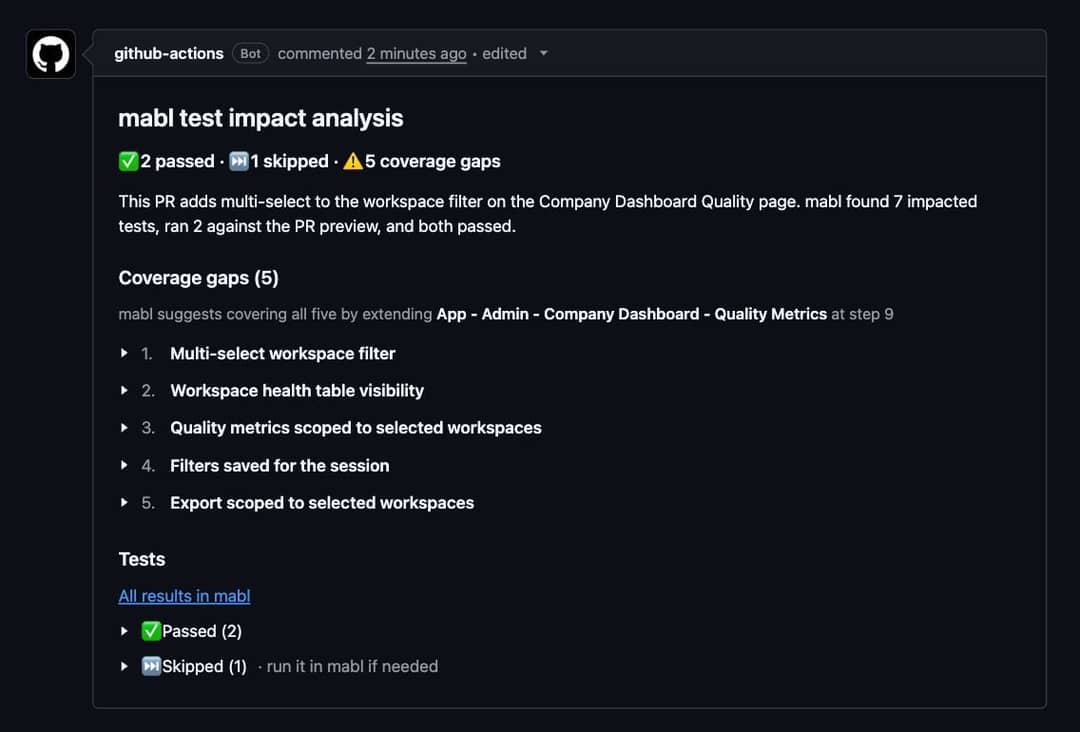
mabl estimates that it saved application development teams about 100,000 engineering hours of testing work in the last 90 days alone, during which its agents analyzed 1.58 million unique failures across 3.3 million sessions. Coding agents also made 3 million calls to the Model Context Protocol (MCP) server provided by mabl, resulting in more than 4,200 tests being created.
It’s not clear how quickly DevOps teams are revamping their approach to testing, but it’s apparent that validating all the code being generated by AI coding tools has become a bottleneck. It’s not feasible for humans to review that code so the need to rely on AI agents to conduct tests is becoming more pronounced, noted Belcher. Historically, code has not been tested as consistently as it should have been, a problem that is now coming to a head in the AI era.
Hopefully, as testing becomes more automated, the pace at which applications are being deployed will accelerate. While there have been some significant gains since the adoption of AI coding tools, the workflows that DevOps teams rely on to validate code before promoting it into a production environment have yet to be revamped to accommodate the volume of code now being generated.
At this juncture, it’s not so much a question of whether those processes and workflows will be revamped as it is how soon. Every time code is rejected during a review, it reduces the value of employing AI coding agents in the first place. In the meantime, however, DevOps teams will need to pay close attention to whether AI coding tools are generating more flawed code than ever—code that may be less secure, harder to debug and more expensive to run as it becomes increasingly verbose.


Mike Vizard is a veteran IT journalist with more than 25 years of experience covering the technology industry, having previously served as Editor-in-Chief of both CRN and InfoWorld and as editorial director for Ziff-Davis Enterprise, where he oversaw titles including eWEEK, CIO Insight and Baseline. Over his career he has also edited or contributed to a wide range of enterprise technology publications, including IT Business Edge, Channel Insider, ComputerWorld, TMCNet and Digital Review, and he later led editorial for CTOEdge.com. His reporting and analysis span software development, cloud computing, cybersecurity, IT channel strategy and, more recently, artificial intelligence and DevOps practices. A recognized voice in enterprise IT journalism, Vizard is known for tracking emerging technology trends as they move from early adoption into mainstream enterprise use. He now serves as Chief Content Officer for Techstrong Group, where he oversees editorial strategy across the full network — devopsy.kinsta.cloud, Security Boulevard, Cloud Native Now, Digital CxO, Techstrong.ai, TechStrong.IT, Techstrong Semi and PlatformEngineering.com — in addition to writing and hosting content for Techstrong TV and the Techstrong Gang podcast.