

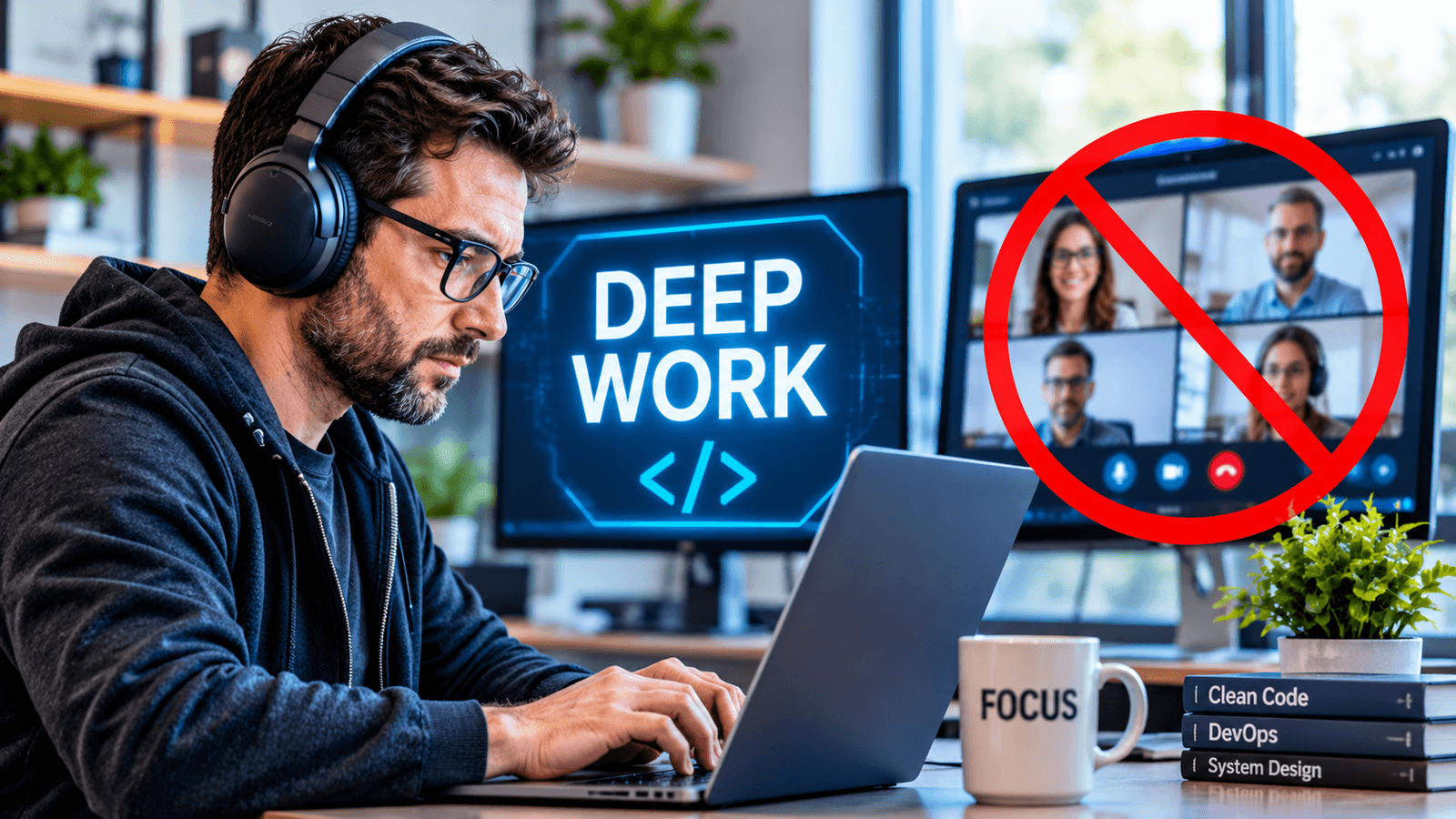
Meeting load has climbed sharply since 2020, and remote meetings in particular have grown even faster than in-person ones. That shift exposed a gap that has always existed between how managers experience a calendar full of calls and how software engineers experience the same thing. For a manager, a meeting is a slot. For a developer in the middle of a complex problem, it is an interruption that costs far more than the thirty minutes it occupies.
That gap has not closed with the arrival of AI coding assistants. If anything, it has widened, because some managers now assume that if an engineer is waiting on a model to generate code anyway, a quick context switch costs nothing extra.
Why Uninterrupted Stretches Matter
Some software engineering work draws on the full capacity of someone’s attention and produces something genuinely novel, such as a design decision, a tricky fix, or a piece of architecture. Researchers who study focus describe this kind of work as incompatible with partial attention. If a task can be handled while half-listening on a call, it is not that kind of work. Other activities, such as answering messages or skimming documents, can tolerate interruptions with less disruption.
Software engineering has historically had more room for the former than most professions, which is part of where the stereotype of the headphone-wearing, heads-down developer comes from.
Engineers who constantly switch between meetings and tasks can lose track of important technical details, make more mistakes, and spend extra time fixing problems that uninterrupted work might have avoided.
The payoff for protecting that “deep work” time shows up in three places: fewer defects reaching review, more work finished per hour (which is really what gives people their evenings back), and faster skill growth, since the hardest problems and the biggest opportunities to develop technical skills often come during long, uninterrupted stretches rather than short ones.
The Real Math Behind an Interruption
Remote work removed the commute but did not remove the noise. The shift did not cut interruptions. It multiplied them, spreading work across more, smaller pieces stretched over a longer day instead of concentrating it into a calmer schedule. After an interruption, people rarely go straight back to what they were doing. They usually drift through two unrelated tasks first, and only then land back on the original one.
That creates two distinct problems. First, work that should demand full attention gets pulled down to the level of something you can half-do on a call — code review is the clearest case. Reviewing a pull request between meetings, instead of blocking real time for it, produces weaker feedback, which produces more bugs, which produces more meetings to fix them. So, it is not a discipline problem on the engineer’s side; it is a scheduling problem on the org’s side.
Second, the ramp-up cost is brutal. Getting into a problem takes roughly 15 minutes, and peak immersion does not arrive until around the 45-minute mark. Every interruption resets that clock.
Research at Meta found that engineers had a median of just two uninterrupted sessions lasting at least 90 minutes per week, illustrating how rarely they get extended periods of concentration. And that is before counting how often a “focus session” gets logged even when it barely reaches a few minutes.
Fix the Culture, Not the Calendar
None of this requires exotic tooling. It requires managers agreeing to a few unglamorous rules: every meeting needs an agenda and a defined outcome, teams protect fixed blocks of meeting-free time (whether that is specific days or specific hours), and invite lists stay small. “Better safe than sorry” invites are the single easiest way to turn a calendar into a minefield, and nobody can reach a state of real focus while half-listening for their name.
Beyond that, the biggest lever is simply removing meetings outright. One engineering organization that studies how top-performing teams operate found a senior engineer whose weekly calendar had no standups, no sprint planning, and no recurring syncs of any kind. Collaboration happened on demand instead of on a schedule. The same organization ran with almost no mandatory code review: engineers merged their own changes and pulled in a reviewer only when they wanted a second opinion or were still ramping up.
That only works with real guardrails. Changes touching authentication, authorization, infrastructure permissions, cryptographic code, or sensitive app data collection still warrant a second set of eyes, no matter how much you trust the author. Self-merge culture works because it is scoped to low-risk changes backed by solid CI, not because review stops mattering.
Teams that require mandatory reviews can still reduce interruptions by setting predictable review periods. Instead of switching tasks whenever a pull request arrives, engineers can review pending changes at agreed times, with a separate process for urgent fixes. Clear response expectations also prevent developers from repeatedly checking whether their changes have been approved.
Commit timestamp analysis across more than 600,000 pull requests showed clear clusters of activity around 9 to 11 a.m. and 2 to 4 p.m., suggesting that teams should protect longer periods of uninterrupted work even where cutting every recurring meeting is not realistic.
Managers also need to follow their own rules. Blocking time for focused work means little if they continue answering every Slack message and expect engineers to do the same. They should protect their own calendars, avoid interrupting colleagues during reserved hours, and make it clear that being unavailable for a couple of hours is acceptable. If managers cannot respect their own focus time, the rest of the team is unlikely to do so.
Chat and phone notifications deserve the same attention as meetings. Teams can establish quiet periods for coding and delay routine notifications while keeping a separate channel available for urgent issues. Engineers can then respond to messages during natural breaks instead of interrupting their work every time someone asks a question. Engineers can also use apps to limit screen time to block distracting sites and personal apps during those coding periods.
Meta’s research found that automatically suppressing chat and phone notifications during coding was associated with a 20% increase in daily personal focus time without reducing communication volume.
Put a Price Tag on the Calendar
There is a structural reason meetings keep multiplying even when people agree they are a problem. Many managers are still measured on visible activity, such as the number of reports filed and status updates completed, rather than on actual delivery outcomes. That incentive rewards unnecessary activity instead of protecting uninterrupted work.
The fix that software engineering teams have found actually moves the needle is blunt: track meeting hours across the team for a sprint or two, multiply by loaded cost, and put the total in front of leadership. Seeing the real number tends to be more persuasive than any argument about focus or flow.
In practice, this quickly reveals two things: meetings that do not need half their attendees and meetings that would work better as written updates. Once managers see the cost, they have a stronger reason to cut unnecessary meetings and ensure the ones that remain have a clear agenda.
Track what changes afterward, not just what got removed. Deployment lead time and change failure rate will tell you whether reclaimed hours turned into better throughput — meeting-hours-saved is a vanity metric on its own.
Not Every Meeting Is the Enemy
The instinct to cut meetings can go too far. Some of the most expensive mistakes in software engineering come from skipping conversations that could have prevented weeks of wasted work, such as a senior engineer pointing out problems with a proposed feature or a small group discussing how a change affects shared architecture.
That is still a meeting, and it is still valuable, focused work. It is simply better held before implementation begins rather than scattered throughout the process. The goal is not to eliminate synchronous collaboration but to protect execution time once a task is properly scoped. This is also not exclusively a developer problem. QA, SRE, and platform engineers performing complex technical work face the same interruptions, often with far less attention given to their impact.
Contain Interruptions Without Disrupting the Whole Team
Failed deployments, urgent device protection alerts, or other security incidents do not wait for a focus block, and no meeting-hygiene rule should pretend otherwise. The fix is not eliminating those interruptions. It is containing them. A rotating engineer handling triage for a week, with access to relevant asset information through existing security and IT integrations, can investigate issues and escalate only those that actually need a second set of hands. This keeps the rest of the team working while someone handles urgent requests.
The real distinction that matters is urgency, not topic: an active outage or a suspected credential compromise justifies pulling someone off what they are doing; a question about next quarter’s roadmap does not.
And when someone does get pulled off a hard problem, a two-line note in the ticket covering the current hypothesis, what has been ruled out, and the next step saves them from re-deriving twenty minutes of reasoning when they get back to it.
Some interruptions can be avoided altogether by reducing dependencies between teams. Clear API contracts, shared documentation, and API mocking let developers keep working without constantly requesting information or waiting for dependent services to become available. Automated integration tests can further reduce the need for repeated coordination by catching compatibility issues early.
Final Thoughts: AI Raises the Stakes
AI coding tools do not reduce the value of sustained attention. They shift where the thinking happens: into the prompt, reviewing what came back, and judging whether it is even the right approach.
Skip that thinking and you get code that “mostly works” and a maintenance bill later, or worse, a genuine AI security problem. None of that gets easier with a fragmented day; it gets harder, because bad context compounds through however many follow-up prompts it takes to fix.
The teams that end up ahead will not be the ones with the fastest model. They will be the ones that worked out how to protect the kind of attention AI cannot substitute for.

Frequently Asked Questions
1. Why do meetings have such a damaging effect on developer productivity?
2. Can AI coding assistants compensate for meeting overload?
3. How can DevOps teams reduce interruptions without compromising collaboration?

Alex Vakulov is a cybersecurity researcher with over 20 years of experience in malware analysis. Alex has strong malware removal skills. He is writing for numerous tech-related publications sharing his security experience. Alex is assisting organizations in making informed decisions to secure their data and assets effectively.